Keywords
Utilization of waste aerated lightweight concrete (ALC) as a planting substrate / Filtration function of ALC-based planting substrate / Soil fungi
Outline of Research at the Start
This study aims to clarify the characteristics of using aerated lightweight concrete (ALC) waste—one of the main types of construction waste with currently limited recycling applications—as a planting substrate, through multiple evaluation criteria. Specifically, planting experiments will be conducted to analyze plant growth, the chemical properties of the substrate, and its relationship with soil fungi (particularly mycorrhizal fungi). In addition, the effectiveness of ALC waste will be examined through water quality analysis of leachate. Through these investigations, the study is expected to provide new insights into extensive and sustainable rooftop greening methods in Japan, and to make significant contributions to their wider adoption, future policy development, and methodological advancement in related research fields.
The key research focuses on the initiatives in collaboration with Sumida Ward, including the creation of a mechanism to promote local greening, rainwater utilization, and environmental education. We are conducting a comprehensive demonstration experiment addressing these issues on the rooftop of Bunka Junior High School in Sumida Ward.
Traditional rooftop greening often involved either transplanting ground-level greenery directly onto the rooftop or planting succulents like sedums on a thin layer of planting base, with little in-depth discussion of the content. However, from the perspective of plants, rooftops present a challenging environment for growth, characterized by intense sunlight and strong winds. In fact, this environment closely resembles coastal conditions. Coastal areas host diverse plant life and ecosystems. Therefore, we decided to create a coastal ecosystem on the roof of the junior high school.
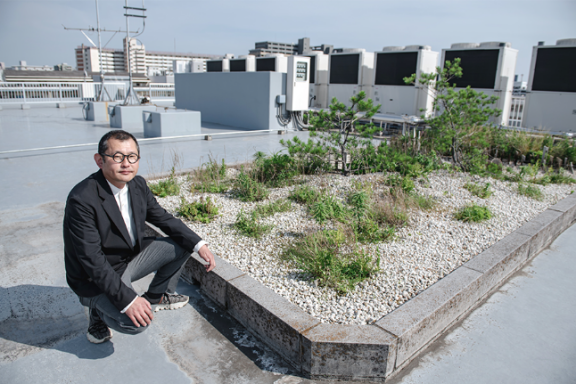
In this project, we decided to use artificial lightweight soil, a type of lightweight inorganic soil. When mixed with organic matter similar to the natural environment, soil tends to degrade over time on rooftops, leading to poor drainage—a condition unfavorable for plants. In comparison, inorganic soil possesses both drainage and water retention capabilities. Additionally, being lightweight, it imposes less load on buildings. Over the past year, I have exclusively relied on rainwater to irrigate the plants, and so far, it seems to be functioning well.
Instead of entirely covering the greenery space with plants, approximately half of it has been covered by gravel. The gravelly areas serve as a welcoming habitat for wild birds, including those known for nest-building on sandy beaches. The planted flowers attract bees and various insects, creating a thriving ecosystem.
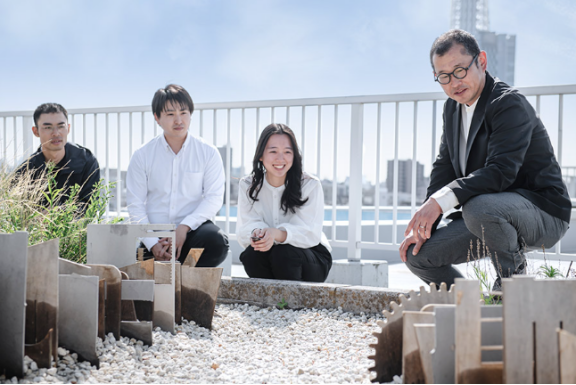
These boards are repurposed scraped Medium Density Fiberboard from the Model Shop, a large workshop on the first floor of the Sumida campus. They now serve as a windbreak on this rooftop greenery. When gazing along the aligned board, you can enjoy views of Mt. Fuji and the Tokyo Sky Tree. Isn’t it delightful to unexpectedly catch a glimpse of Mt. Fuji beyond the rows of boards?Through this rooftop greening initiative, our aim is for junior high school students to recognize their school building as a truly enjoyable place. By encouraging frequent visits to the rooftop, I hope to provide students with opportunities to learn about the surrounding landscape and the local ecosystem.